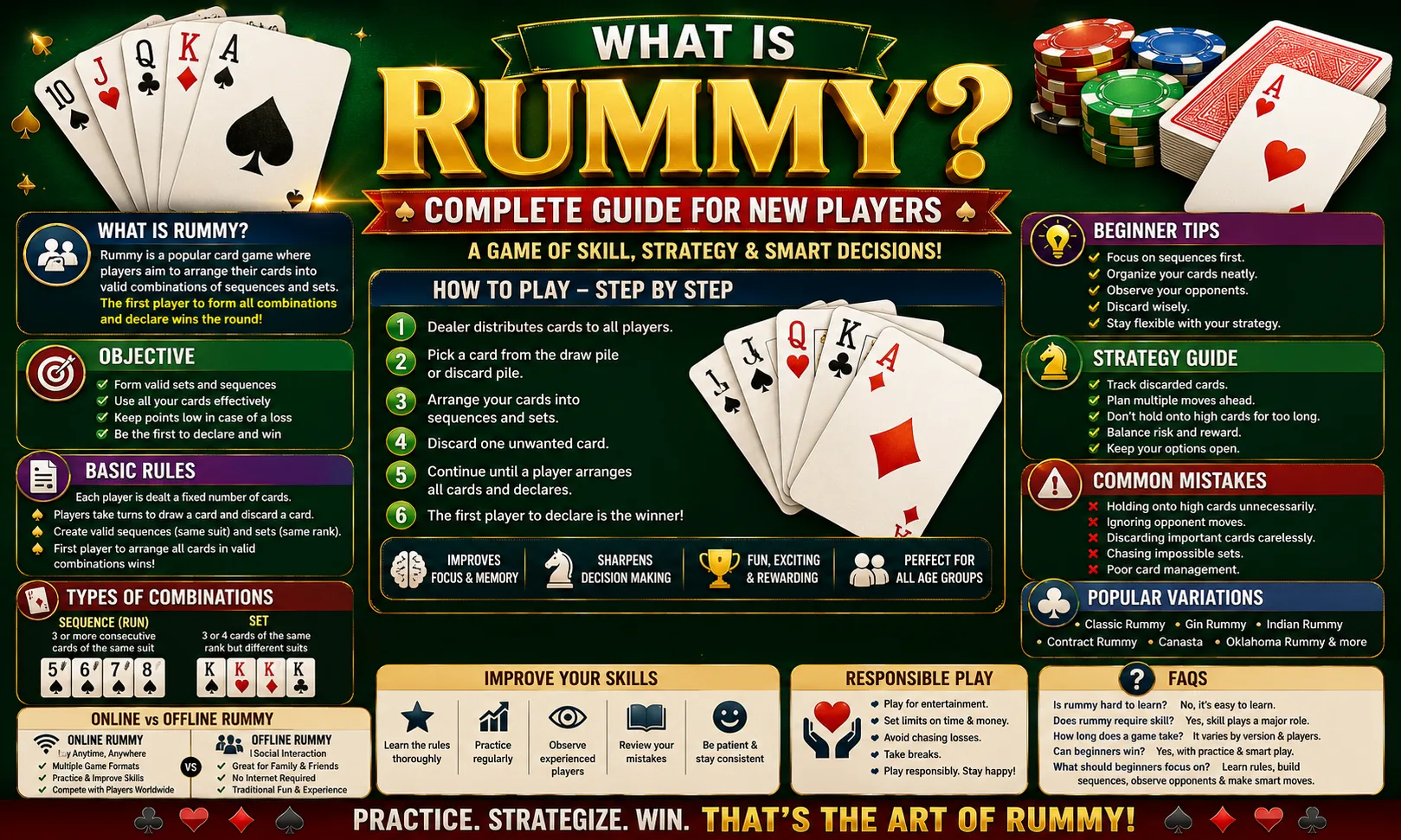
What Is Rummy? Complete Guide for New Players
Introduction
Rummy is one of the world’s most popular card games, enjoyed by millions of players across different countries and cultures. It is a game of skill that challenges your observation, planning, memory, and decision-making abilities. Unlike games that rely entirely on luck, success in rummy comes from understanding the rules, creating the right card combinations, and making smart choices throughout the game.
Whether you are completely new to card games or simply want to understand how rummy works, this guide will walk you through everything you need to know. From the basic rules and card values to popular variations, beginner strategies, common mistakes, and frequently asked questions, this article covers all the essential information in one place.
ALL RUMMY APPS LIST ⬇️

Download Rummy Pride 2026

What Is Rummy?
Rummy is a matching-card game in which players aim to arrange the cards in their hand into valid combinations. These combinations generally consist of:
- Sequences (Runs): Three or more consecutive cards of the same suit.
- Sets: Three or four cards of the same rank but different suits.
The main objective is to organize all your cards into valid combinations before your opponents do. The player who successfully completes all the required combinations according to the game rules wins the round.
Although luck influences which cards you receive, skill plays a much bigger role in deciding the outcome. Experienced players carefully observe opponents’ moves, calculate probabilities, and make strategic decisions to improve their chances of winning.
Brief History of Rummy
The exact origin of rummy is still debated. Historians believe that modern rummy evolved from older matching-card games played in Europe during the nineteenth century. Over time, different countries developed their own variations, making rummy one of the most widely played card games worldwide.
Today, rummy is enjoyed both casually among family and friends and competitively in organized tournaments and online platforms.
Objective of the Game
The goal of rummy is straightforward:
- Arrange every card into valid combinations.
- Form the required sequences according to the game’s rules.
- Finish before other players.
Winning depends on making efficient combinations while minimizing unmatched cards.
Understanding the Deck
Most versions of rummy use a standard deck of 52 playing cards.
The deck contains four suits:
- Hearts
- Diamonds
- Clubs
- Spades
Each suit contains thirteen cards:
- Ace
- 2–10
- Jack
- Queen
- King
Some variations use more than one deck depending on the number of players.
Card Values
Understanding card values is important.
Generally:
- Number cards carry their face value.
- Jack, Queen, and King are face cards.
- Ace may act as either the lowest or highest card depending on the variation.
Always check the specific rules of the version being played.
Basic Terms Every Beginner Should Know
Sequence
Three or more consecutive cards from the same suit.
Example:
5♠ 6♠ 7♠
Set
Three or four cards of identical rank from different suits.
Example:
8♥ 8♦ 8♣
Draw
Taking one card from either the draw pile or discard pile.
Discard
Placing one unwanted card into the discard pile.
Meld
Displaying completed combinations.
Download Rummy Most 2026

Basic Rules of Rummy
Although different versions have small rule differences, the core gameplay remains similar.
- Every player receives a fixed number of cards.
- Remaining cards form the draw pile.
- One card starts the discard pile.
- Players take turns.
- Each turn consists of:
- Drawing one card.
- Arranging cards.
- Discarding one card.
- The first player to complete all valid combinations wins.
How to Play Rummy Step by Step
Step 1: Receive Cards
Each player is dealt cards at the beginning of the game.
Study your hand carefully before making your first move.
Step 2: Identify Possible Combinations
Immediately look for:
- Existing sequences
- Existing sets
- Cards close to forming sequences
Step 3: Draw a Card
On your turn:
Choose one card from:
- Draw pile
- Discard pile
Your decision should improve your hand.
Step 4: Rearrange Cards
After drawing:
- Build sequences
- Build sets
- Remove weak combinations
Step 5: Discard
Discard one card that contributes the least toward your objective.
Never discard a card that may help complete an important sequence unless absolutely necessary.
Step 6: Continue Playing
Repeat these steps until someone completes all valid combinations.
Why Skill Matters
Many beginners think rummy is purely luck-based.
Actually, skilled players consistently perform better because they:
- Observe opponents.
- Plan several moves ahead.
- Manage risks.
- Track discarded cards.
- Adapt their strategy.
Good decision-making often makes a significant difference.
Popular Variations of Rummy
Different regions have created unique versions of the game.
Some popular variations include:
- Classic Rummy
- Gin Rummy
- Indian Rummy
- Contract Rummy
- Canasta
- Oklahoma Rummy
While rules differ slightly, the central idea of forming valid card combinations remains the same.
Beginner Tips
Focus on Sequences First
Sequences are usually easier to build than multiple sets.
Organize Your Cards
Arrange cards by suit and rank.
This helps you quickly identify opportunities.
Observe Opponents
Watch which cards they:
- Pick
- Ignore
- Discard
These actions reveal useful information.
Think Before Discarding
A careless discard may help another player.
Always consider whether your discarded card could complete an opponent’s combination.
Stay Flexible
Don’t become attached to one strategy.
Adapt according to the cards you receive.
Intermediate Strategy
As your experience grows, begin using more advanced techniques.
Track Missing Cards
Mentally remember important discarded cards.
If several required cards have already been discarded, change your plan.
Create Multiple Possibilities
One card should ideally contribute to more than one potential combination.
This increases flexibility.
Balance Risk and Reward
Sometimes waiting for one perfect card is risky.
A slightly weaker combination may be safer.
Plan Several Turns Ahead
Experienced players rarely think about only the current move.
They prepare future combinations while minimizing unnecessary risks.
Common Mistakes Beginners Make
Keeping High Cards Too Long
Holding unnecessary cards reduces flexibility.
Ignoring Opponent Behavior
Every draw and discard provides information.
Many beginners fail to notice these clues.
Chasing Impossible Combinations
If required cards are no longer available, adjust your plan instead of waiting endlessly.
Poor Card Organization
Messy hands lead to missed opportunities.
Rushing Decisions
Take a few moments to evaluate every move carefully.
Download Rummy Apple 2026

Improving Your Skills
The best way to improve is through consistent practice.
Useful habits include:
- Learning the rules thoroughly.
- Practicing regularly.
- Reviewing mistakes.
- Observing experienced players.
- Remaining patient.
Skill develops gradually through experience.
Online vs. Traditional Rummy
Traditional Rummy
Advantages:
- Social interaction.
- Family entertainment.
- No internet required.
Online Rummy
Advantages:
- Convenient access.
- Multiple game formats.
- Practice opportunities.
- Play anytime.
Regardless of the format, understanding the rules and making thoughtful decisions remain essential.
Responsible Play
Rummy should always be enjoyed responsibly.
Keep these principles in mind:
- Play for entertainment.
- Set personal limits on time and spending where applicable.
- Avoid chasing losses.
- Take breaks.
- Stop playing if it stops being enjoyable.
Responsible habits help keep the game fun.
Frequently Asked Questions
Yes. The basic rules are straightforward, and most beginners can understand them after a few practice games.
Yes. While the cards you receive involve chance, planning, observation, and decision-making have a major influence on success.
The duration varies depending on the number of players and the specific variation being played.
Absolutely. Regular practice and learning from experience help improve performance over time.
Start by understanding the rules, recognizing valid sequences and sets, organizing your cards, and making careful draw and discard decisions
Conclusion
Rummy is more than just a card game—it is a rewarding exercise in strategy, observation, and thoughtful decision-making. Learning the fundamentals, understanding card combinations, organizing your hand effectively, and practicing consistently can greatly improve your confidence and overall performance.
For new players, the key is to focus on the basics before exploring advanced strategies. As your experience grows, you’ll become better at reading the game, adapting your plans, and making smarter decisions. Whether you play casually with friends or simply want to master the fundamentals, a strong understanding of the rules and regular practice will help you enjoy rummy while steadily improving your skills.
Leave a Reply